The Workbench Journal
🇨🇦 Proudly Canadian
← Back to the Journal

DR FARM: The Philosophy Behind Everything We Build

design-process engineering how-it-works behind-the-bench

Here at the Small World Workshop, we follow an engineering philosophy that was glanced over briefly in an engineering class at University. I haven't heard wide mention of it since, but it has become very important here. It is at the core of everything we do.

The framework is called DR FARM—and if you've walked through our workshop, you may have spotted the poster hanging on the wall. Six colourful blocks, each one a letter, each one a stage in the design process. It looks simple. In practice, it's a discipline.

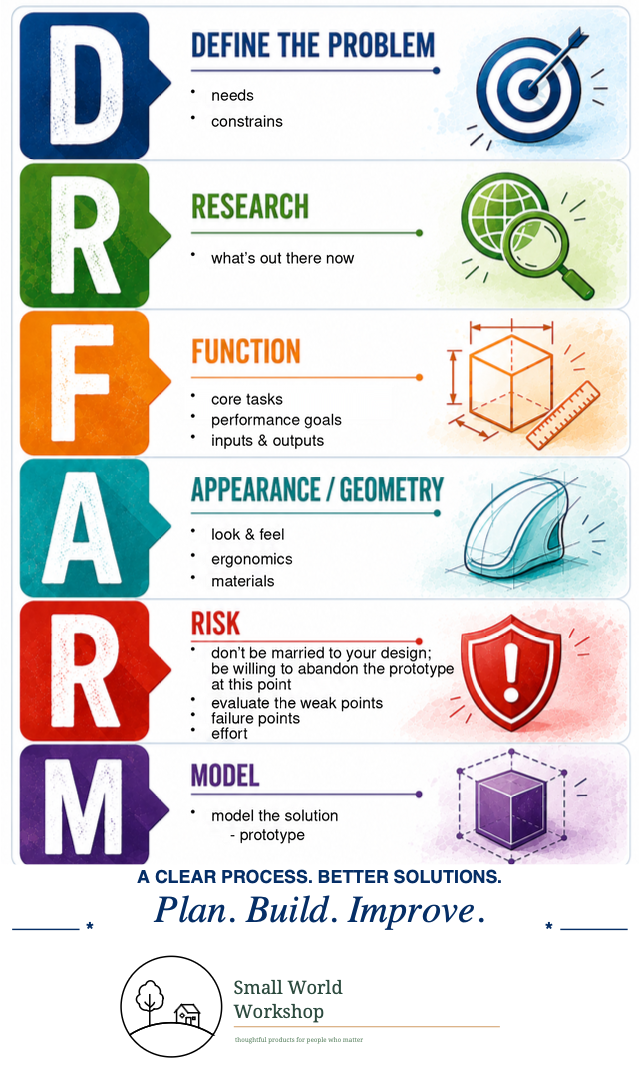
The DR FARM poster: six colour-coded stages — Define the Problem, Research, Function, Appearance/Geometry, Risk, and Model — each with an illustrated icon. Tagline: A clear process. Better solutions. Plan. Build. Improve.
The DR FARM poster, as it hangs on our workshop wall.

Here's what each step means—and why we take it seriously.

D
Define the Problem

Before a single component is ordered or a CAD file is opened, we ask: what problem are we actually solving? This means getting specific about needs—who is this for, and what do they genuinely require?—and constraints: cost, size, environment, available materials, time. A poorly defined problem is the most expensive mistake you can make in product development, because you might build the wrong thing perfectly.

R
Research

Once the problem is clear, we look hard at what's already out there. Not to copy, but to learn. What has been tried? What works, and what doesn't? Where are the gaps? Good research saves enormous amounts of time and often surfaces solutions or components you'd never have thought of on your own. Standing on the shoulders of what's already been done is not a shortcut—it's good engineering.

F
Function

Now we ask: what must this thing actually do? Function is about defining the core tasks, the performance goals, the inputs and outputs. Before worrying about what something looks like, we nail down what it needs to accomplish. Form follows function—but only if you've been honest about the function first.

A
Appearance / Geometry

With function locked in, we can think about form. What shape makes sense? What are the ergonomics? What will the user actually touch, see, and interact with? Materials come into play here too—not just for aesthetics, but because the choice of material often has real implications for manufacturing, durability, and cost. This is where a product starts to feel like something real.

R
Risk

This is the step most people skip, and it might be the most important one. Before you commit to building, you need to honestly evaluate the weak points in your design. Where is it most likely to fail? Is the effort required still justified by the expected return?

But there's a subtler risk to manage too: attachment bias. By this stage, you've invested real time and thought into your design, and it's tempting to fall in love with it. The DR FARM framework asks you to be willing to walk away from your prototype at this point—to abandon it entirely if the honest risk assessment says you should. That's hard. It's also necessary.

M
Model

If you've made it through the risk stage with your concept still standing, now you build. The model could be a physical prototype, a CAD model, a breadboard circuit, or even a detailed sketch—whatever lets you test your assumptions against reality. Then you refine. Then you iterate. The model stage isn't the end of the process; it feeds right back into Define as you learn what the design actually needs.

Why DR FARM?

Most design frameworks move in a straight line from idea to product. DR FARM has a checkpoint built in—the Risk stage—that forces you to pause and question everything before you spend real money and time on a build. That pause has saved us from bad ideas more than once.

We've printed the poster, hung it on the wall, and referred back to it more times than we can count. If you'd like one for your own workshop or classroom, we've made it available below. Plan. Build. Improve.
Take the poster home.
A clear process. Better solutions.
↓  Print one for your workshop or classroom