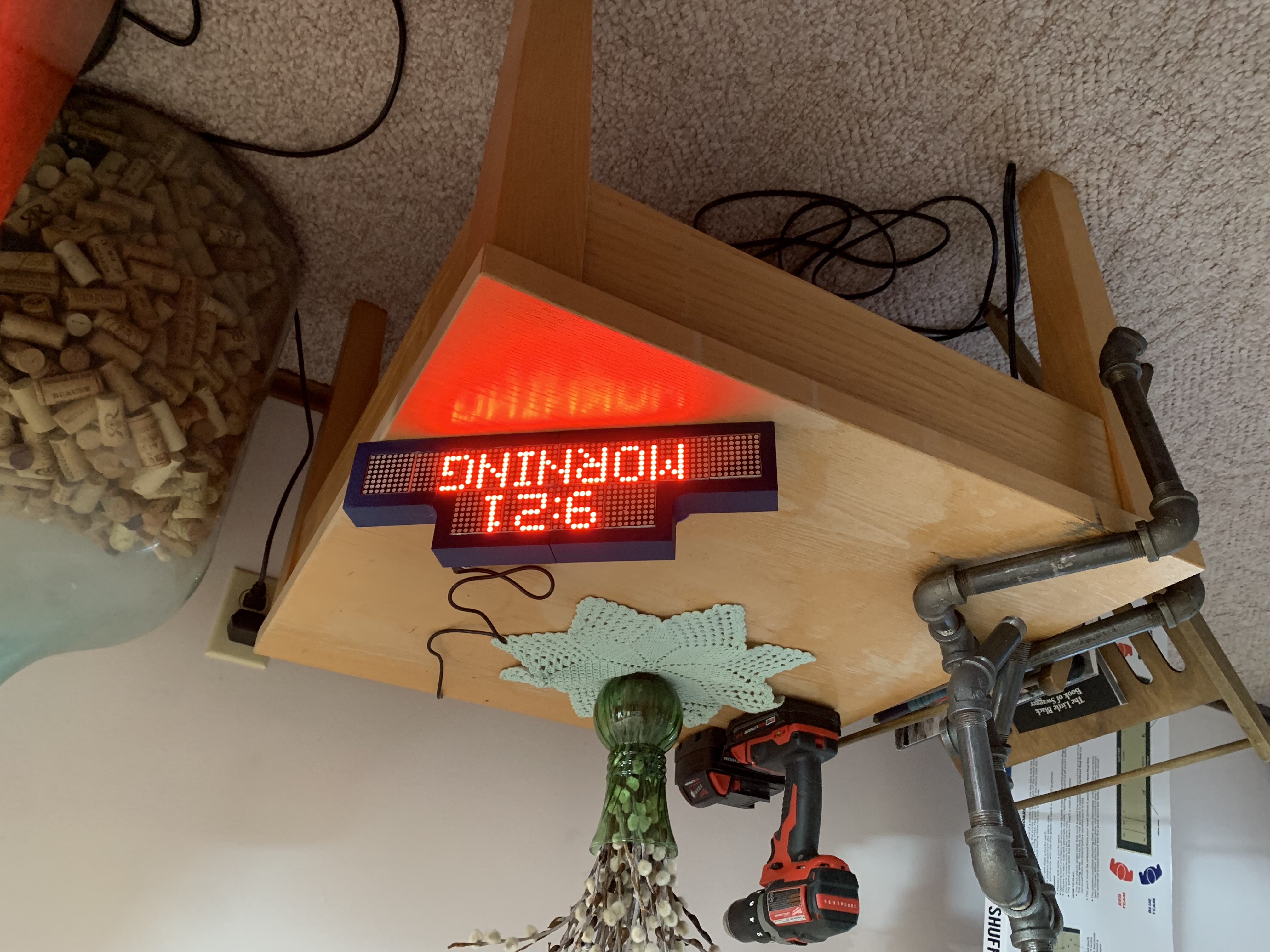
In a room, at a distanceReadable across the room without glasses, day or night
For Seniors · In development · Proudly Canadian
It shows the time, and it shows what the time means. Two lines, one word, nothing else. It hangs on a wall, or sits on an end table or night stand, and tells the truth, continuously, for years.
For someone in early-stage cognitive decline, “what time is it?” is really two questions: what the clock says, and what that means. A person can read 3:00 perfectly well and still not know whether to get dressed or go back to bed.
Day/night disorientation is one of the earliest and most disruptive symptoms. Waking at 3am certain it’s morning. Getting dressed for the day at dusk. Refusing dinner because it feels like breakfast. Phoning a daughter four times before sunrise. The distress doesn’t come from not knowing the time — it comes from not being able to place it.
Ordinary clocks are built for people who can still do that placing themselves, so they fail in specific ways:
Analog faces require reading hand positions — an abstraction that degrades early.
Digital clocks mark AM/PM with two small letters, easy to miss and meaningless once the abstraction has slipped.
Most displays are dim and low-contrast, with small characters, read from across a room by aging eyes.
Smart displays scroll, animate, rotate photos, and rearrange themselves. Motion reads as something is happening, and every layout change demands fresh interpretation.
Screens sleep, dim, throw up notifications, or lose the network and go blank.
After a power blip, most clocks blink 12:00 — confidently wrong, which is worse than nothing.
A clock that is blank or wrong at 3am doesn’t merely fail to help; it becomes the cause of the incident. Reliability isn’t a spec here, it’s the whole product.
Two lines. The time, large, on top. One word underneath, in capitals: MORNING, AFTERNOON, EVENING, NIGHT.
Nothing else is on the screen, and nothing moves except the digits when the minute changes.
The word does the real work — it answers the question actually being asked. Word recognition holds up longer than symbolic reasoning, and a word can’t be confused the way a small sun and a small moon can.
There is nothing to press, swipe, dismiss, or set up.
Never blank.
Nothing moves.
Legible from across the room.
No interaction required from the person using it.
Configured once by a caregiver, then invisible.